
Cursive handwriting worksheets help children learn flowing script, improve handwriting speed, and develop fine motor skills. Our cursive handwriting worksheets include guided letterforms, cursive writing practice sheets, and printable cursive alphabet pages to support teachers and parents.
Download Free PDF Cursive Handwriting Worksheets
Find printable cursive alphabet pages and cursive handwriting practice worksheet PDFs below.
Cursive Handwriting Alphabet Worksheets
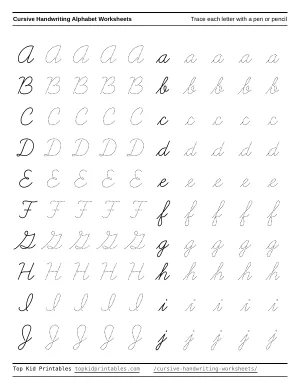
These worksheets contains both upper and lowercase cursive letters. Cursive alphabet printable letters A to Z and a to z.
3 Page Cursive Handwriting Alphabet Worksheet A to Z
This PDF file consists of 3 pages that cover the cursive letters A to Z, a to z, and some short practice words.
- Page 1 covers A to J and a to j, as the sample image below shows.
- Page 2 covers K to T, and k to t.
- Page 3 covers U to Z, and u to z. In addition, page 3 includes short cursive practice words.
Click the image or the download button below to open the full 3 page PDF file.
What are cursive handwriting worksheets?
Cursive handwriting worksheets are printable learning pages designed to teach children how to write letters using connected strokes. Instead of practicing random words, children follow guided tracing lines, copy examples, and complete writing activities that reinforce proper letter formation.
Cursive handwriting worksheets may include:
- Uppercase and lowercase letters
- Guided tracing lines
- Independent writing practice
- Words beginning with each letter
- Short sentences
- Blank handwriting lines for extra practice
Using structured worksheets helps children learn consistent letter shapes while developing pencil control and muscle memory.
Why use cursive handwriting worksheets?
Using cursive handwriting worksheets helps students build legible, efficient handwriting. Repeated, guided practice with cursive writing practice sheets improves muscle memory and confidence. Many educators find that cursive handwriting worksheets support reading fluency and spelling retention.
Many children find cursive easier than print once they understand how the letters connect naturally. Regular practice develops smooth hand movements while improving writing speed and confidence.
Benefits include:
- Better fine motor coordination
- Improved hand strength
- Greater writing fluency
- Better letter recognition
- Increased writing confidence
- Stronger spelling reinforcement
- Improved focus during writing lessons
Daily cursive writing practice helps children become comfortable writing without lifting the pencil after every letter.
How to use Cursive handwriting worksheets effectively
Start with individual letters before moving to connected words. Use handwriting worksheets daily in short sessions. Model the movement and encourage students to trace, then write independently. Pair cursive writing practice with sensory activities (sand trays, finger paint) for stronger motor skill development.
Children typically learn cursive in stages as shown in the following table.
| Stage | Skill |
|---|---|
| 1 | Practice basic strokes |
| 2 | Learn lowercase letters |
| 3 | Learn uppercase letters |
| 4 | Connect letters into words |
| 5 | Write short sentences |
| 6 | Build writing speed and consistency |
Working through cursive handwriting worksheets in this order prevents children from becoming overwhelmed.
When Should Children Begin Cursive?
Many children are ready between ages 7 and 9 after developing solid print handwriting skills.
Signs a child is ready include:
- Comfortable pencil grip
- Consistent print letter formation
- Ability to copy words accurately
- Good hand-eye coordination
- Interest in learning cursive
Every child develops differently, so readiness is more important than age.
How Often Should Children Practice?
Ten to fifteen minutes of cursive writing practice several times each week is enough for most learners. Consistency produces better handwriting than occasional long practice sessions.
A simple weekly schedule might look like this:
| Day | Activity |
|---|---|
| Monday | Lowercase letters |
| Tuesday | Uppercase letters |
| Wednesday | Words |
| Thursday | Sentences |
| Friday | Review favorite worksheets |
Making Cursive Writing Practice Fun
Children stay motivated when handwriting activities feel rewarding.
Try these ideas:
- Use colorful pencils.
- Practice one letter each day.
- Write family members’ names.
- Create handwritten greeting cards.
- Copy favorite quotes.
- Keep a handwriting journal.
- Celebrate progress with stickers.
Short, consistent sessions are usually more effective than long practice periods.
Tips for Using the Cursive Handwriting Worksheets
- Begin with lowercase letters and introduce uppercase later.
- Keep practice short and consistent: 5–10 minutes daily for steady progress.
- Use a lined guide or dotted midline to support correct letter height and slant.
- Incorporate name practice and simple words once letters are secure.
- Try varied writing tools (crayons, markers, pencils) and reward progress with stickers.
- Focus on neatness before speed.
- Encourage slow, careful letter formation.
- Practice consistently throughout the week.
- Avoid correcting every small mistake.
- Celebrate improvement instead of perfection.
- Review difficult letters regularly.
- Keep practice sessions short and positive.
- Allow children to choose favorite words to write.
Did You Know?
Cursive practice can improve cognitive development by linking motor skills with language. Historically, cursive was essential for written communication; while technology has changed writing habits, cursive remains useful for signatures and personal notes. Cursive instruction has been linked to improved neural development in areas related to reading and memory. These worksheets complement classroom instruction and home learning routines.
Cursive writing develops more than handwriting skills. Because connected writing uses continuous movements, many children improve their hand coordination and writing rhythm through regular practice.
Research has also shown that handwriting activities support memory, letter recognition, and early literacy development. Even in today’s digital world, practicing handwriting remains an important educational skill that complements keyboarding rather than replacing it.
Many historical documents, family letters, and personal journals were written in cursive, making it a valuable lifelong skill for reading as well as writing.
Frequently Asked Questions (FAQ)
When should children start cursive handwriting worksheets?
Many educators recommend beginning cursive around 2nd or 3rd grade, once print handwriting is fluent and letter formation is consistent.
Are cursive handwriting worksheets free?
Yes. Top Kid Printables offers free cursive writing practice sheets and printable cursive alphabet pages for home and classroom use, downloadable as PDFs.
How often should students use handwriting worksheets?
Short, regular practice sessions (5–15 minutes daily) are most effective for building cursive fluency without fatigue.
Can cursive handwriting worksheets help with spelling and reading?
Yes, practicing connected letters reinforces letter sequences and word patterns, which can support spelling retention and reading fluency.
Should children trace letters before writing independently?
Yes. Tracing helps develop muscle memory before children write letters without guides.
Are cursive writing practice sheets suitable for homeschooling?
Absolutely. They provide structured lessons that work well for homeschool, classroom, tutoring, and independent practice.
What is included in a cursive alphabet printable?
A cursive alphabet printable typically contains every uppercase and lowercase cursive letter with tracing guides and independent writing lines.
How can I make cursive writing practice more enjoyable?
Use games, colorful supplies, reward charts, creative writing activities, and short daily lessons to keep children motivated.
Can beginners use a cursive writing practice worksheet?
Yes. Beginner worksheets usually include large letters, arrows, dotted tracing, and extra writing space.
Related Resources
You may enjoy our Number Tracing Worksheets for number writing practice.
Conclusion
Cursive handwriting worksheets are a valuable tool for teaching flowing script and improving handwriting speed. Download our free cursive writing practice sheets and cursive alphabet printable PDFs to help your child gain confidence with cursive writing. Regular use of cursive handwriting worksheets supports fluency, fine motor development, and a strong foundation for written communication.